If you are considering orthodontic treatment and want a discreet option, you may be asking, how long does transparent braces treatment take? For patients exploring orthodontic care in Deira, Dubai, treatment duration is an important part of deciding whether transparent braces fit their needs and lifestyle.There is no single answer because every smile is different. The time required depends on the position of the teeth, the severity of crowding or spacing, the bite, the type of transparent appliance used, oral health, and how consistently the patient follows the treatment plan.Some cases may involve relatively simple tooth movement, while more complex alignment or bite concerns can require a longer treatment period. Understanding the factors behind treatment duration can help you prepare realistically and make informed decisions about orthodontic care.
So, how long does transparent braces treatment take? The answer varies from patient to patient.
In general, orthodontic treatment may take several months to a few years, depending on the complexity of the case. A relatively simple alignment concern may progress faster than a case involving significant crowding, spacing, rotated teeth, or bite correction.
The treatment duration is influenced by:
A dental professional can provide a more meaningful estimate after examining the teeth and evaluating the bite.
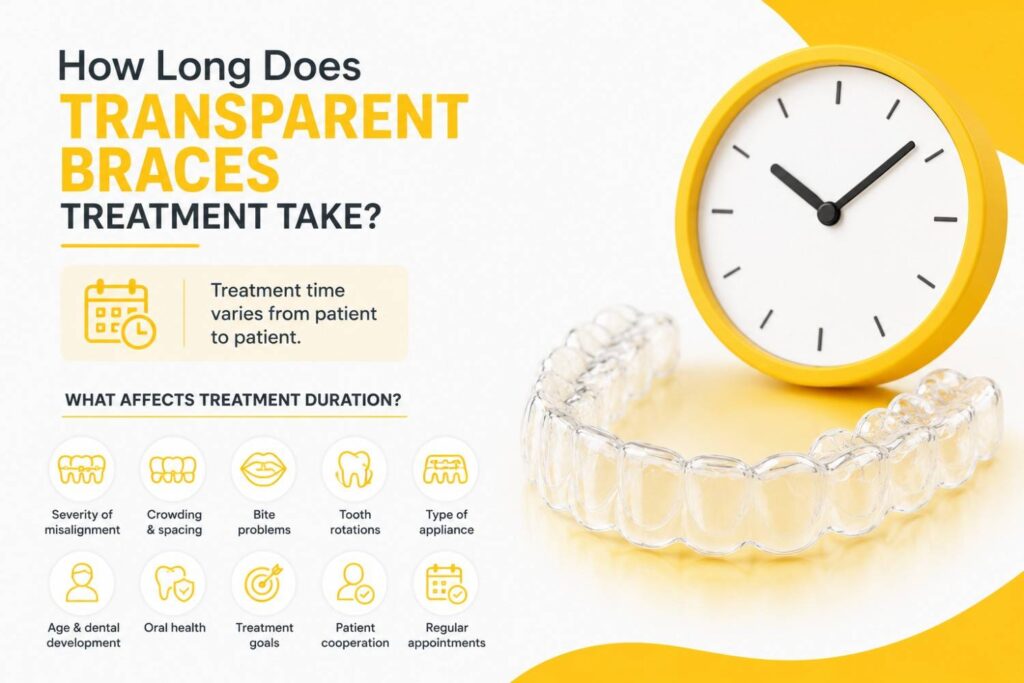
Understanding the factors that influence treatment duration can make the answer to how long does transparent braces treatment take much clearer.
Crowding occurs when there is not enough space for teeth to align properly.Mild crowding may require relatively straightforward movement. Moderate or severe crowding may require additional planning and more extensive tooth movement.The greater the correction required, the longer treatment may take.
Gaps between teeth can also require orthodontic correction.The size and number of spaces, as well as the reason they developed, can influence the treatment plan. Some spaces may be related to tooth size, missing teeth, or differences in the dental arch.Closing spaces safely requires controlled movement rather than simply pulling teeth together quickly.
Orthodontic treatment may involve more than straightening visible teeth.Problems such as overbite, underbite, crossbite, or uneven tooth contact can make treatment more complex.When bite correction is required, treatment may take longer because the dentist needs to coordinate the position of multiple teeth and sometimes both dental arches.
Some teeth are not only crooked but also rotated around their normal position.Rotated teeth can require carefully controlled movement. Depending on the amount of rotation and the tooth involved, correction may take additional time.
Not all discreet orthodontic appliances work in exactly the same way.Ceramic or tooth-coloured braces are fixed appliances, while clear aligners are removable trays. Their treatment planning, maintenance, and suitability can differ.The appliance should be selected according to the correction needed rather than appearance alone.The provided pillar content notes that clear aligners are removable and may be suitable for some conditions, while ceramic and tooth-coloured braces remain fixed to the teeth.
Healthy teeth and gums are important before and during orthodontic treatment.Existing dental problems may need attention before active orthodontic movement begins. Maintaining good oral hygiene throughout treatment can also help prevent complications that might interfere with progress.
Patient cooperation can have a significant impact on treatment progress.For fixed transparent braces, this may include following food and hygiene instructions and attending scheduled appointments.For clear aligners, wearing the trays according to the prescribed schedule is especially important.Not following instructions can affect how consistently the planned tooth movements occur.
Understanding why teeth become misaligned can also explain why treatment duration differs.
Common contributing factors include:
Sometimes several factors contribute to one orthodontic problem.For example, larger teeth within a smaller dental arch can contribute to crowding. Missing teeth may contribute to spacing. Differences in jaw development can influence the way the upper and lower teeth meet.The supplied pillar content identifies genetics, jaw structure, tooth size, missing or extra teeth, early loss of primary teeth, oral habits, and uneven dental development as possible contributing factors.
When discussing how long does transparent braces treatment take, it is useful to understand what type of appliance is being considered.
Not everyone with misaligned teeth experiences symptoms. Some people mainly notice the appearance of their smile.
Possible signs include:
These signs do not automatically mean transparent braces are necessary.
A professional dental examination is needed to identify the cause of the problem and determine whether orthodontic treatment is appropriate.
One of the main reasons people choose transparent orthodontic appliances is their appearance.Ceramic and tooth-coloured braces are generally less noticeable than conventional metal brackets.
Transparent braces can help guide teeth toward improved positions when they are appropriate for the patient’s condition.Better alignment may improve the overall appearance of the smile and support a more balanced bite.
Crowded or overlapping teeth can make brushing and flossing more difficult.Once orthodontic correction is completed, improved tooth positioning may make some areas easier to access during daily cleaning.
Orthodontic treatment can address certain problems involving the way the upper and lower teeth meet.The exact benefits depend on the individual’s condition and treatment plan.
Some adults and teenagers prefer orthodontic appliances that are less noticeable.A discreet appearance can make it easier for patients to feel comfortable continuing normal professional, academic, and social activities.The supplied pillar content also identifies discreet appearance, tooth alignment, oral hygiene access, bite function, confidence, individualized planning, and multiple orthodontic options among the potential benefits.
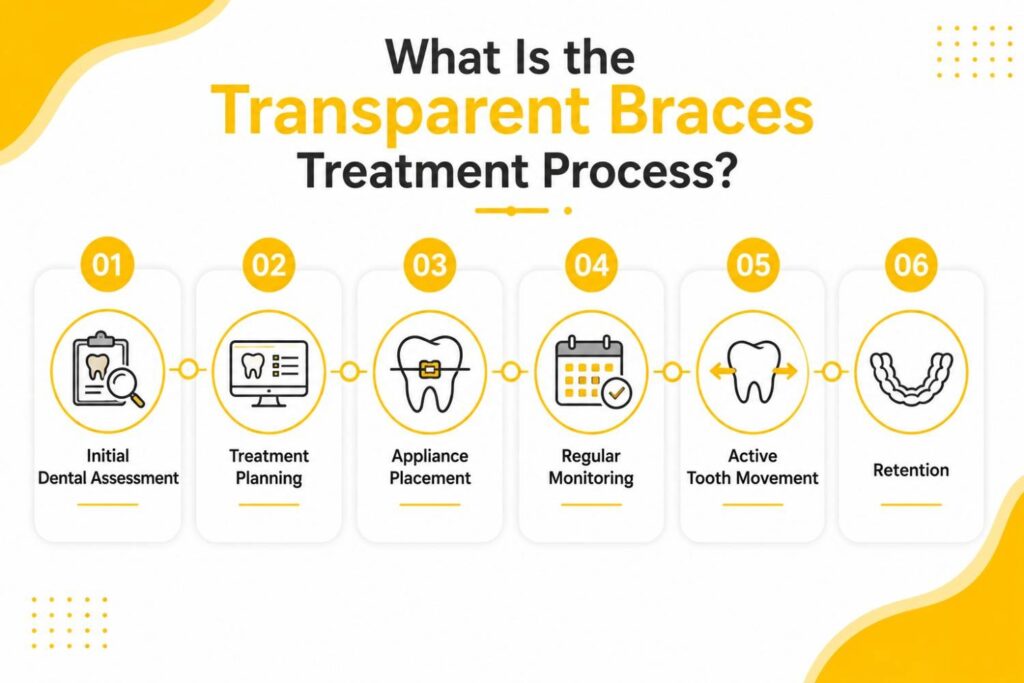
Understanding the treatment process can help explain how long does transparent braces treatment take.
The dentist examines the teeth, gums, bite, and overall oral health.Depending on the case, dental records or imaging may be required.
The dental team identifies the orthodontic problems and determines the movements required.The treatment plan may include the expected sequence of tooth movement and an estimated treatment duration.
For fixed transparent braces, brackets are attached to the teeth and connected with orthodontic wires.For clear aligners, the patient receives trays according to the planned treatment sequence.
Follow-up appointments allow the dentist or orthodontist to evaluate progress.Adjustments may be made when necessary.
The teeth gradually move according to the treatment plan.The exact pace differs between individuals.
After active orthodontic treatment, retainers are commonly used to help maintain the corrected tooth positions.Retention is an important part of the overall orthodontic process.
Some temporary pressure or tenderness can occur when orthodontic treatment starts or after adjustments.
Patients may notice:
These sensations can occur because the appliance is applying controlled forces to move the teeth.
Severe, persistent, or unusual discomfort should be discussed with the dental team.
The supplied pillar content similarly describes mild tenderness, pressure, temporary sensitivity, and minor irritation as possible experiences during orthodontic treatment.
Both transparent and traditional braces can be used for orthodontic correction.
The primary differences often involve appearance and materials.
| Feature | Transparent Braces | Traditional Braces |
|---|---|---|
| Appearance | More discreet | More noticeable |
| Brackets | Ceramic or tooth-coloured options | Usually metal |
| Fixed treatment | Available | Available |
| Oral hygiene | Requires careful cleaning | Requires careful cleaning |
| Suitability | Depends on dental condition | Depends on dental condition |
| Treatment planning | Individualized | Individualized |
The appropriate choice should depend on the orthodontic problem, not appearance alone.
Several issues can make orthodontic treatment take longer than initially estimated.
Potential factors include:
This does not mean that treatment delays are always preventable. Some cases naturally require additional time as the teeth respond to treatment.
When considering transparent orthodontic treatment, look beyond the appearance of the appliance.
Important considerations include:
A discreet appliance may be attractive, but the most important consideration is whether it is appropriate for the dental correction required.
The pillar content also recommends considering professional assessment, treatment planning, orthodontic experience, monitoring, oral hygiene guidance, appliance care, and retention when choosing transparent braces.
So, how long does transparent braces treatment take? There is no fixed timeline that applies to everyone. Treatment can vary according to crowding, spacing, tooth rotation, bite complexity, oral health, appliance type, treatment goals, and patient cooperation.Transparent braces can provide a discreet way to improve tooth alignment for suitable patients. Ceramic braces, tooth-coloured braces, and clear aligners each have different features, and the right option should be selected after a professional assessment.Following dental instructions, maintaining good oral hygiene, attending follow-up appointments, and caring properly for the appliance can support steady treatment progress.If you are considering how long does transparent braces treatment take and want a personalized estimate, a professional orthodontic assessment can help explain the expected timeline and suitable treatment approach. For patients exploring orthodontic care in Deira, Dubai, an individual consultation can provide clearer guidance based on their teeth, bite, and treatment goals.To learn more about orthodontic treatment and maintaining good oral health, visit the American Dental Association’s MouthHealthy resource.
At our clinic, we take pride in our highly skilled and efficient team of dental specialists who are always ready to meet your dental needs.










Dream Smile Dental Clinic
Banyas square, Metro Station, Behind whitefort Hotel, Lilly Centre – Office No: 106, Deira, United Arab Emirates, UAE
WhatsApp us